Freshwater conditions in early Paleolake Olduvai from the Naibor Soit Formation
Gebregiorgis, D., et al.
Palaeogeography, Palaeoclimatology, Palaeoecology · 2026
Investigating how natural and anthropogenic forcings shape East African and South Asian monsoons, climate extremes, and locust–climate dynamics across human and geological timescales.
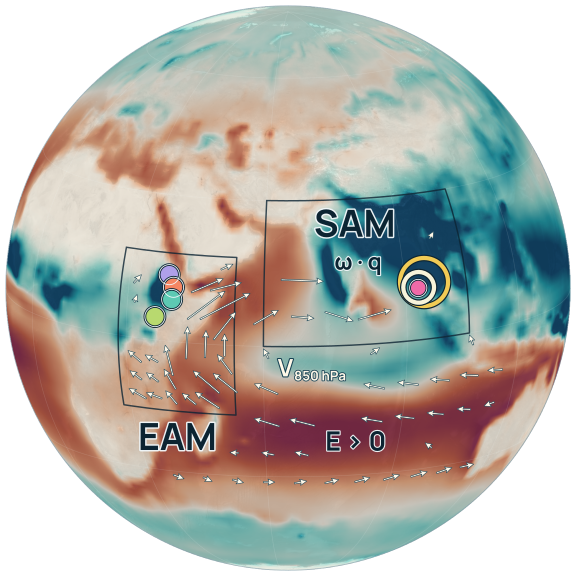
ERA5 via WeatherBench 2, with 61-day climatology smoothing. P−E is precipitation minus evaporation estimated from surface latent heat flux. Wind arrows cover the Indian Ocean and the EAM and SAM domains, with closer spacing within EAM. Winds are omitted where the 850 hPa level lies below the average land surface. E > 0 denotes upward evaporation; it does not indicate positive P−E. The SAM annotation ω · q denotes conceptual thermodynamic–dynamic interaction; no ω or q field is displayed. V with subscript 850 hPa denotes the full horizontal wind vector. EAM means East African monsoon; SAM means South Asian monsoon. Boxes show illustrative research domains, and East African rainfall seasons vary by region. Data and methods.
Gebregiorgis, D., et al.
Palaeogeography, Palaeoclimatology, Palaeoecology · 2026
Gebregiorgis, D., Asrat, A., Birhane, E., et al.
npj Sustainable Agriculture · 3, 29
Gebregiorgis, D., Deocampo, D. M., Foerster, V., et al.
Frontiers in Earth Science · 9, 607695
Gebregiorgis, D., Deocampo, D. M., Longstaffe, F. J., et al.
Geophysical Research Letters · 47, e2019GL085576
Atmosphere · 10(8), 432
Gebregiorgis, D., Hathorne, E. C., Giosan, L., Clemens, S., Nürnberg, D., & Frank, M.
Nature Communications · 9, 4702
Try another search term or research area.
Research in development
We are developing sedimentary ancient DNA approaches to investigate past ecological change and locust activity. Our collaborative simulation work examines pesticide resistance in locusts, expanding the lab’s research on biological responses to environmental change and human intervention.
Investigating links among climate variability, environmental change, dietary shifts and hominin evolution in East Africa through sedimentary and geochemical archives.
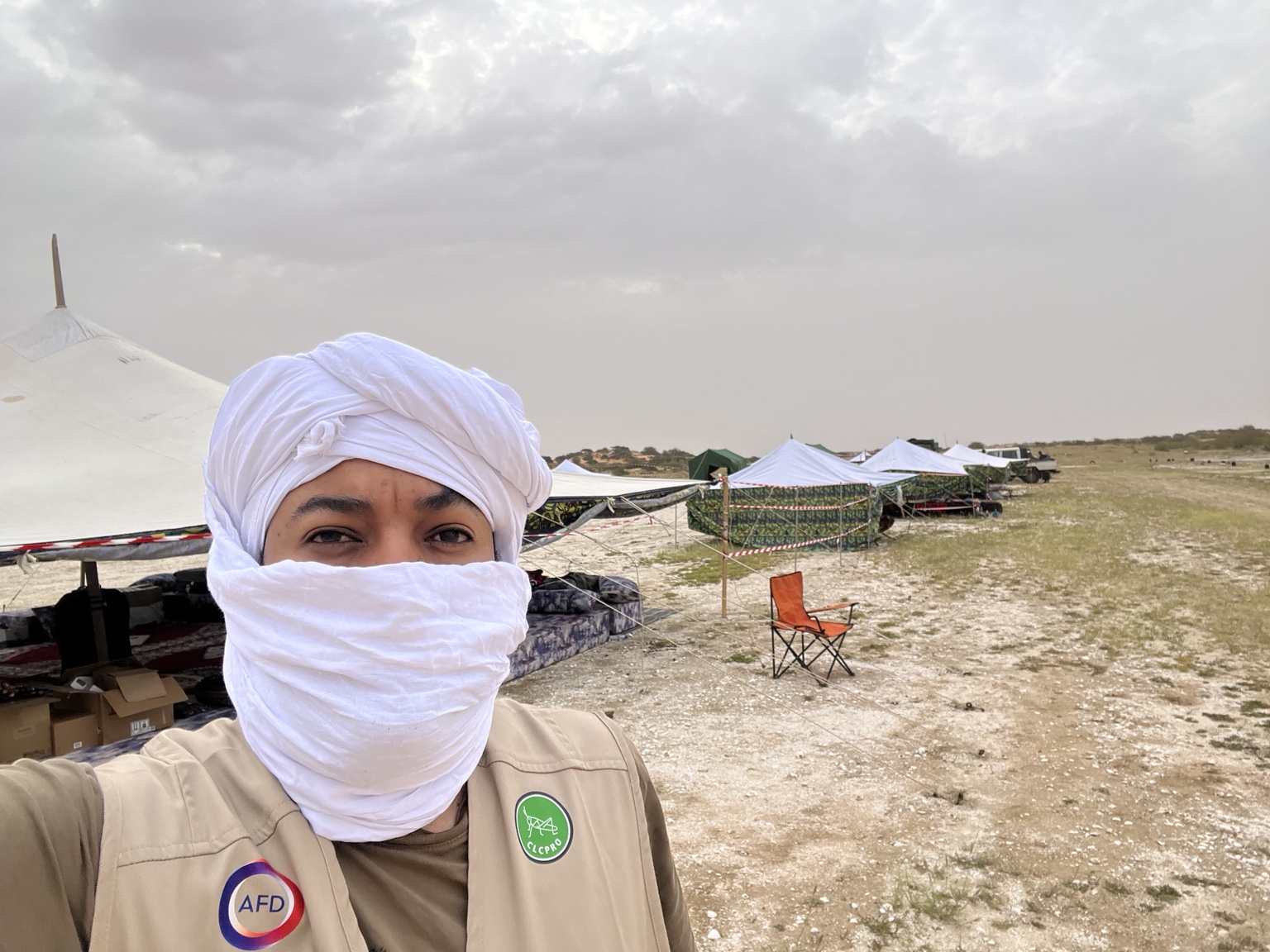
Daniel Gebregiorgis is an assistant professor and climate scientist in the Department of Geosciences at Georgia State University. His research, grounded in geochemistry, primarily focuses on understanding past East African and South Asian monsoon dynamics to shed light on key mechanisms underpinning the response of the monsoon systems to continued greenhouse gas emissions. An overarching focus of his research remains investigating the mechanisms and rates of change that characterized Earth’s past climate variability, as well as the influence of large-scale coupled ocean–atmosphere circulation patterns, including the El Niño–Southern Oscillation (ENSO) and the Indian Ocean Dipole (IOD), on regional monsoons. As a natural extension of his research on monsoon dynamics, his recent work examines how changes in rainfall and water availability shape locust outbreak regimes and reconstructs the climatic and environmental context of hominin evolution in East Africa. He holds a Bachelor of Science in Earth Science with a minor in Mathematics from Addis Ababa University, a Master of Science in Atmospheric Science from the University of Gothenburg, and a Ph.D. in Geosciences from the University of Kiel.
Recent talkLocusts, monsoons & livelihoods · Kavli 2025
Interested in graduate or postdoctoral research? Discuss Opportunities (dgebregiorgis@gsu.edu)